
PROJECTS
GAMES AND CULTURE
About Games and Culture ↑
Background
As part of a graduate course on designing online learning for higher education, I led a team in the design & development of a fully asynchronous undergraduate course exploring the intersection of games and culture. Our job was to design a cohesive, engaging learning experience within the constraints of Brightspace, an LMS, while addressing the unique challenges of asynchronous learning to foster connectivity and interaction.
This project intially took place during September 2025-December 2025, with future iterations are still in development.
Roles:
Project Manager
Content Design Lead
Writer
Tools:
Brightspace
Google Gemini (course shell vibecoding)
Challenge ↑
In our course, we defined games as interactive experiences for one or more players, bound by rules, and played mostly while sitting down. Our topic and goals are all about connection. But with an entirely asynchronous class, how can we foster interaction with both the materials and their classmates?
Key Challenges of an Asynchronous Course:
- Fragmented sense of connection with classmates
- Feeling like you’re talking to void
- Harder to get help when struggling with coursework
- Motivation and participation can wither without the accountability of group
Our goal was to create meaningful interaction without synchronous instruction, using only the tools available within Brightspace.
Constraints:
- Fully asynchronous (no required live sessions)
- LMS-bound delivery (Brightspace only)
- Compressed timeline (2 months of research & preparation, 1 month of production)
Solutions:
- Leveraged team members as subject matter experts (SMEs)
- Designed for interaction within constraints, not around them
- Prioritized structured, repeatable interaction patterns across the course
Design Frameworks ↑
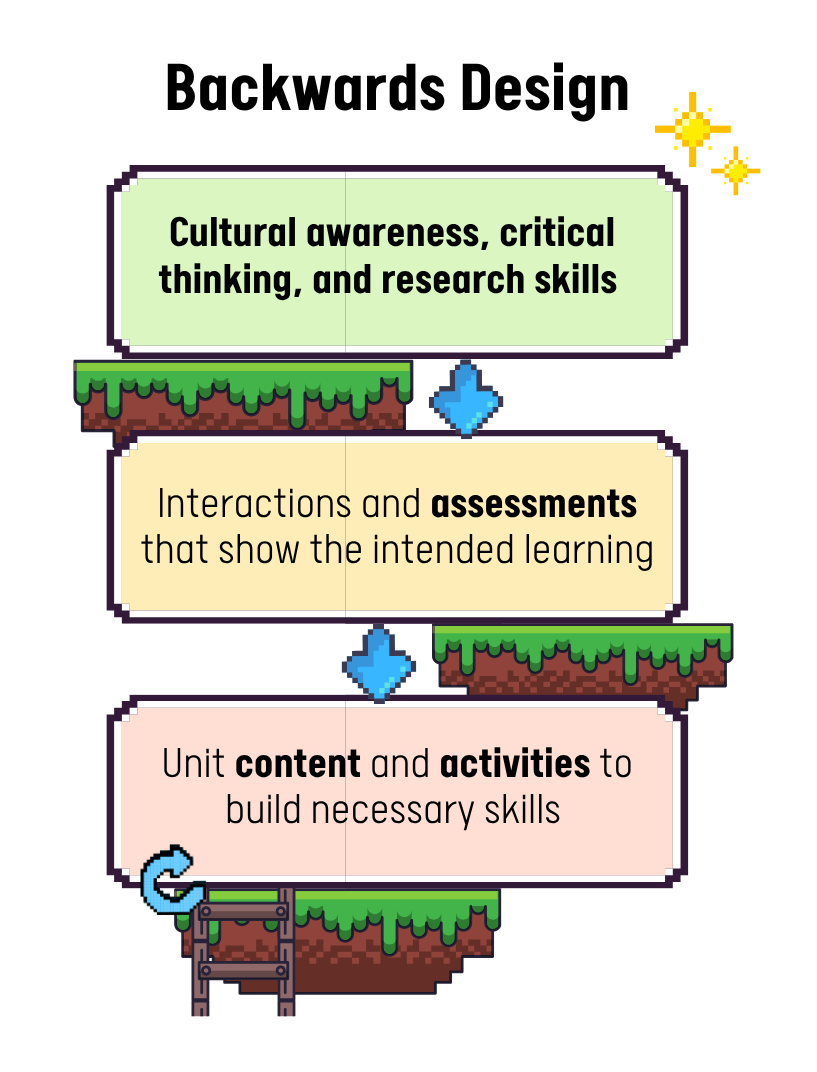
Since we had a broad topic in mind that could be approached many ways, we decided to use backwards design to build out our course. We began with long-term learning goals—cultural awareness, critical thinking, and research skills—and designed assessments and activities to directly support them.
Goals, Outcomes, and Objectives:
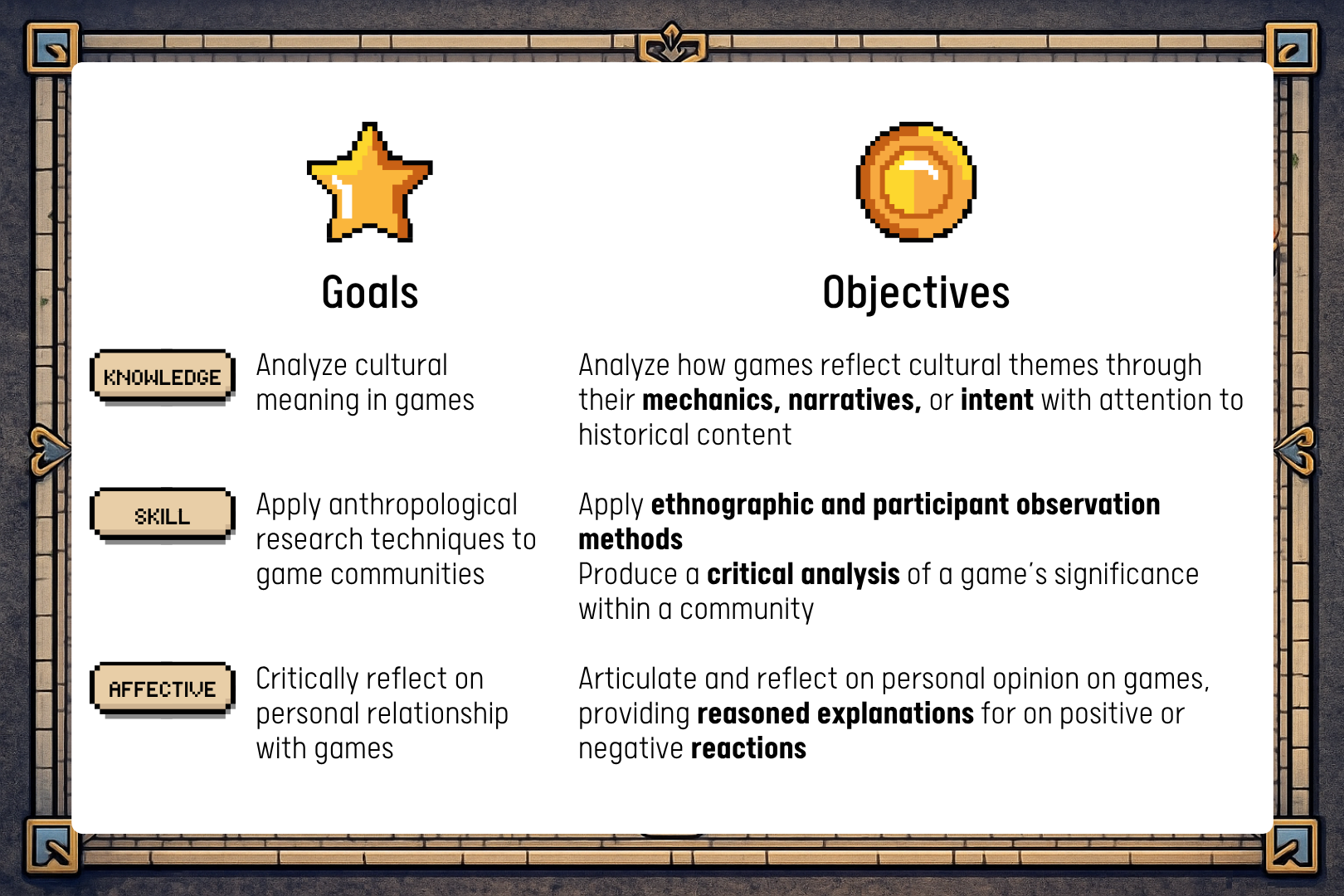
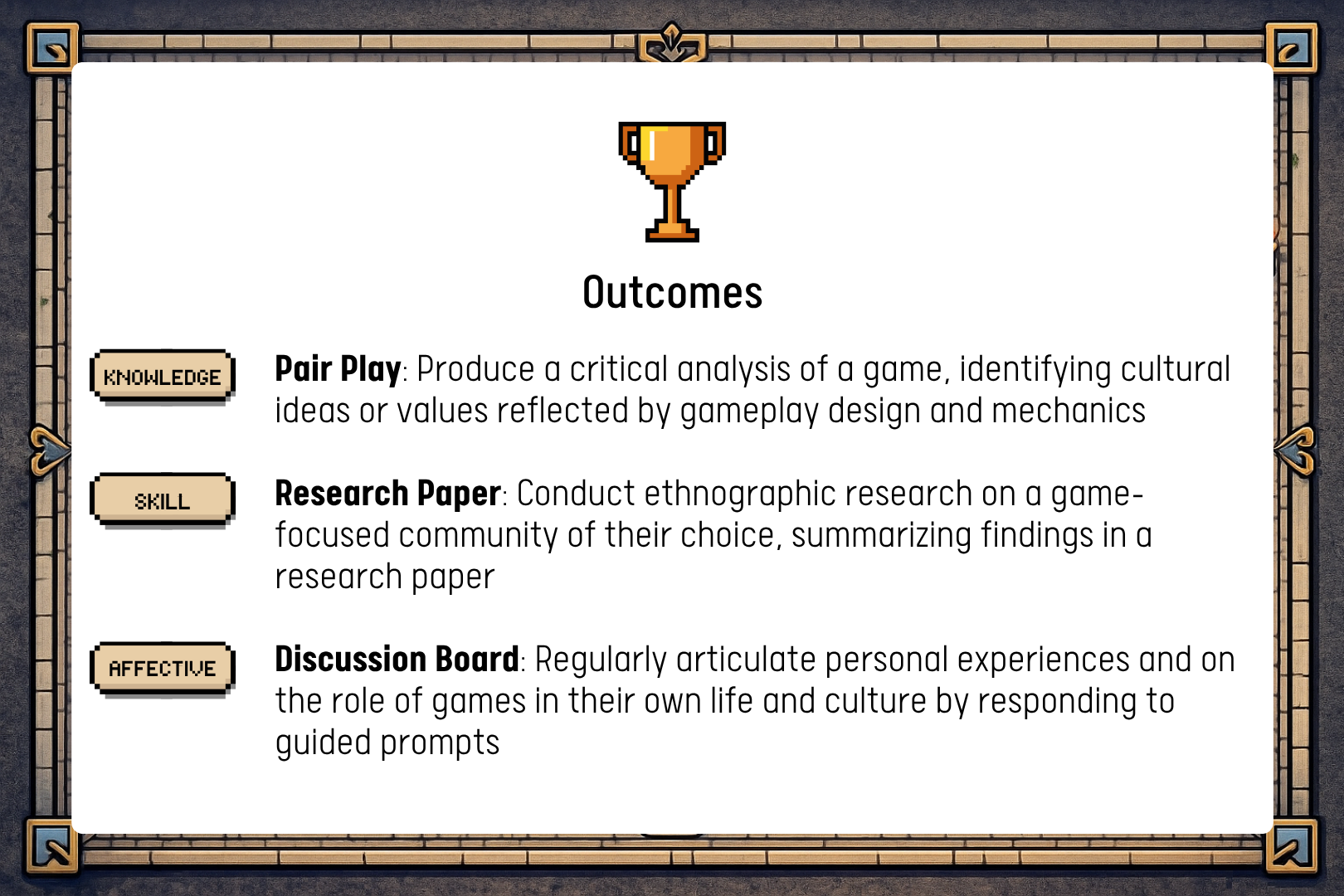
We designed the course to develop three key analytical, research, and reflective skills that we felt were key for the students’ current aims and future goals.
- Knowledge: Analyze cultural meaning in games
- Skills: Apply ethnographic research methods to game communities
- Affective: Critically reflect on personal relationships with games
We then used rapid iteration to build and refine the course, utilizing the Successive Approximation Model (SAM) to turn rough ideas into detailed modules:
- SME-led outlines
- Collaborative drafts with integrated media
- Iterative feedback cycles
- Final content development, creation, and refinement - my key role
While we all took a module each during the drafting stage, as the content lead, I led the feedback cycles and the final content development, creating and editing the unit material as well as building the course template. Our SMEs gave their final approval on the multimedia, and I created the pages on Brightspace using our template. This process allowed us to move quickly while maintaining alignment across modules, assignments, and learning objectives.
Learning Design & Theory ↑
Social Learning in an Asynchronous Space
For our course, we focused on designing structured peer interaction to combat isolation and strengthen knowledge gain. Drawing on the UDL principle of fostering collective learning, we used constructivist theories to help us design activities with the aim of supporting meaning-building through interaction.
Discussion Boards
Guided prompts encouraging reflection and dialogue
Emphasis on responding, not just posting
Pair Play Assignment
Guided prompts encouraging reflection and dialogue
Emphasis on responding, not just posting
Peer Review
Integrated into the research process to support iterative learning
Embedded, Real-Time Interaction
In order to promote deeper learning and increased engagement, we leveraged interactivity to support active learning among the students. There’s no traditional class time for students to discuss, so we wanted to give them a space to communicate their thoughts organically. To simulate “in-the-moment” engagement:
- In-video annotations using Brightspace tools
- Instructor-guided annotation prompts to guide reflection and contribution
- Embedded polls and collaborative slides (e.g., Mentimeter)
These elements created a sense of presence and participation within the static world of an LMS, providing a space for real-time sharing of ideas.
Student-Centered Learning Path
More than anything, we emphasized autonomy and relevance. The modules were designed to be anchored in real-world game case studies, connecting theory to games they may already be familiar with.
In addition, asynchronous classes rely heavily on intrinsic motivation, so to address that, we wanted to provide students an opportunity to exercise choice and follow their passions. Students could choose:
- Games to analyze
- Communities to research
- Topics and sources to share with the class
The reflection prompts were designed to encourage metacognition, asking students to examine their biases, play experiences, and evolving perspectives.
Scaffolding Learning
The final research project required students to conduct ethnographic research on a game-based community.
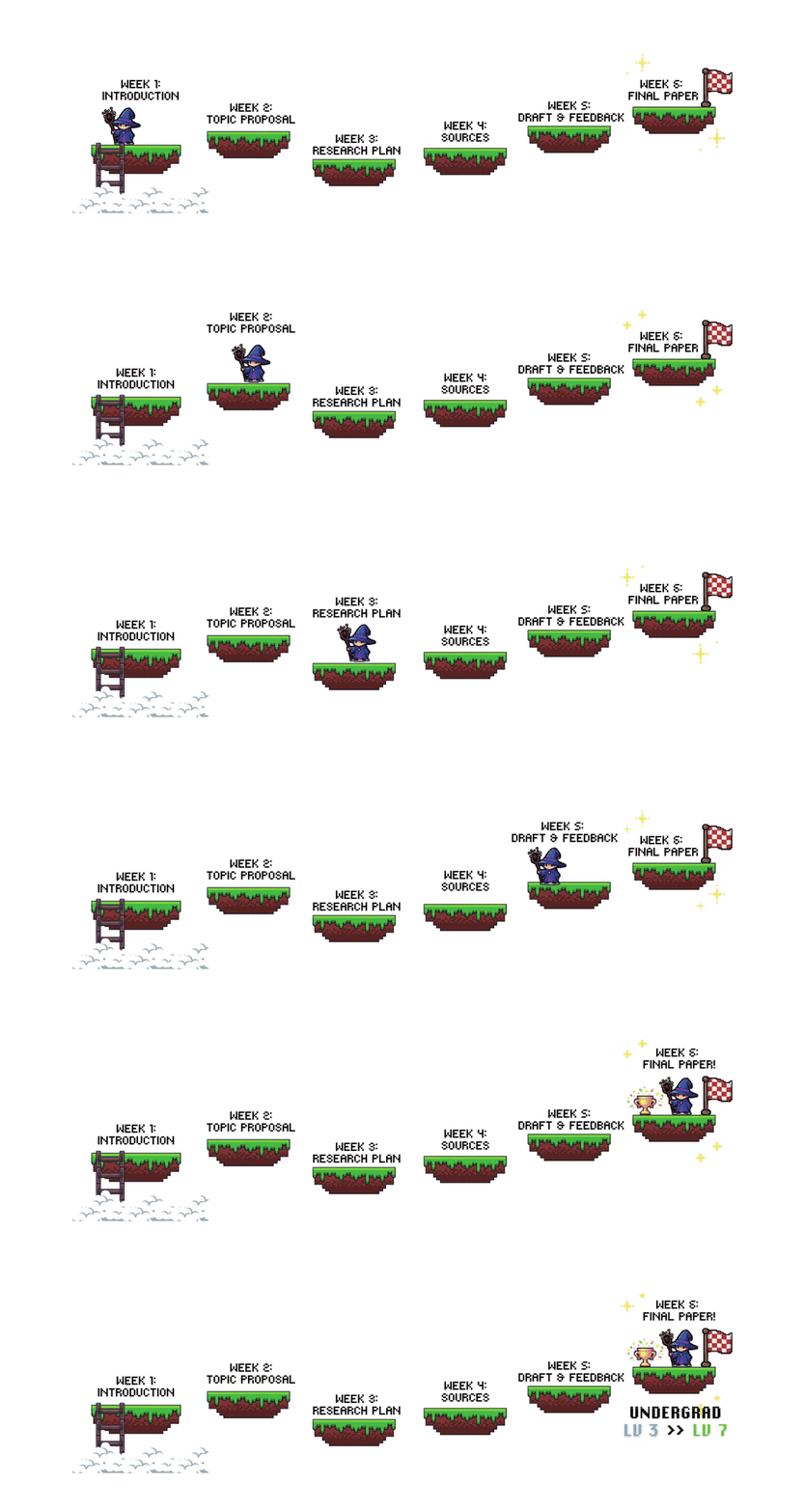
To support students, we scaffolded the process across the course:
- Early assignments introduced relevant concepts, like anthropology and the role of games in society
- Mid-course activities provided structured practice
- Peer feedback supported iterative approaches to writing
- The final deliverable synthesized learning, both content & process
This approach reduced cognitive load while promoting skill transfer and confidence.